Coming soon on Amazon
The Qur’an-Centric Method
Everything else is commentary.
A Qur’an-centric guide back to the source, written for the confused, the disheartened, and the ones still thinking.
By Ahmad Popalyar
- Chapters
- 23
- Parts
- 5
- Pages
- 590
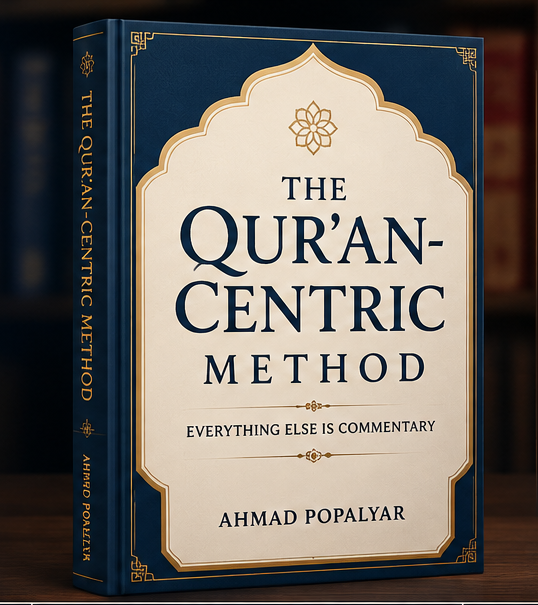
About the book
A return to the source, not a rejection of scholarship
In a time when guidance is often sought through layers of opinions and interpretations, this book returns to the source. It presents the Qur’an as al-Furqan, the final Criterion by which every religious claim, ruling, and inherited doctrine is weighed and tested. The authentic Sunnah and the scholarship of the Ummah retain their honored place beneath that Criterion—subordinate and answerable to it, not discarded by it.
The argument is not that fourteen centuries of scholarship should be discarded. It is that scholarship belongs in its proper station: as commentary, answerable to the source, and never a substitute for it.
Written for three kinds of reader
The confused
Readers who have been handed contradictory rulings by equally confident authorities, and want a way to weigh them.
The disheartened
Readers who kept the faith but lost trust in the institutions that claimed to speak for it.
The ones still thinking
Readers unwilling to trade inherited certainty for easy doubt, and willing to test every claim at the source.
“The Qur’an is the light by which every other evidence is seen. A candle is not brought to judge the sun.”
The method
What Qur'an-centrism is, and what it is not
Qur'an-centrism is not “Qur'an-only.” The difference is not a matter of degree. It is a matter of order.
It is not
- Discarding Arabic grammar, history, or the Sunnah of the Prophet
- Treating fourteen centuries of scholarship as worthless
- Replacing the scholars with a reader’s private opinion
It is
- Placing the Qur’an above the commentary written about it
- Receiving reports and rulings with gratitude, as the branch
- Testing every claim, including the author’s, against the Book
Three names the Qur'an gives itself
- Al-FurqanThe Criterion
- The standard by which every other claim is measured.
- Al-MizanThe Balance
- The scale on which competing readings are weighed.
- Al-BurhanThe Proof
- The decisive evidence that settles what reports cannot.
The method rests on a single conviction. No ruling, doctrine, or inherited opinion can bind a believer's conscience unless the Qur'an itself confirms it. Reports and scholarly conclusions are received with gratitude, but they remain the branch, tested against the root, and never the root tested against the branch.
It is also a path toward unity. The Qur'an is Habl Allah, the Rope of Allah, which the Ummah is commanded to hold fast to together, and by which it is commanded not to be divided. When the Book is restored as the shared criterion, no sect, school, or scholar can impose a private inheritance as the final word, because the final word already belongs to a text every believer can open, question, and test.
Every claim in this book is offered as accountable to the Qur'an, falsifiable by the Qur'an, and correctable by the Qur'an. The goal is not agreement with the author. The goal is to hand the reader the means to think, to weigh, and to return every claim to the Book.
What's inside
Table of Contents
Twenty-three chapters across five parts, moving from the Qur’an’s own testimony to the discipline of reading it, and then to the method applied across the questions that matter most.
- Chapter 1. The Qur’an’s Self-Description
- Chapter 2. The Book Judges Everything: The Criterion as First Principle
- Chapter 3. The Book Is Its Own Dictionary: Meaning from Within
- Chapter 4. One Book, No Contradiction: Reading Verse Against Verse
From the preface
Why I Wrote This Book
4 min read
I want to begin not with an argument but with a confession, because the argument of this book was born from the failures it cost me to make. I am not a scholar in the way the word is usually meant. I hold no ijaza, I sat in no madrasa, I memorized no chains of narrators in my youth. What I have instead is a long, often painful apprenticeship in being wrong, and in discovering, each time, that the thing which finally set me right was the Book itself.
I am writing to restore the Qur'an to its rightful place, above the tradition, not buried beneath it. Everything else in this book is, quite literally, commentary on that one conviction.
I am from Afghanistan. When I was a child my home was destroyed, and my family joined the long river of the displaced flowing out of a broken country. We settled in Peshawar, and I grew into my youth the way the overwhelming majority of Muslims in the world grow into theirs: certain of my faith, and almost entirely ignorant of its contents. I was a Muslim; that was a fact, fixed and unquestioned. But I was a Muslim the way one is a citizen of a country one has never read the laws of.
Then, on a school bus in Canada, a classmate named Andrew, an Egyptian and a Coptic Christian, quoted a verse of the Qur'an to prove that it taught the opposite of “turn the other cheek.” He had mistranslated it; the verse condemns arrogance, not gentleness. But I did not know that. I was stunned into silence. A Coptic Christian on a Canadian school bus understood my own Book better than I did.
I did not walk away from that bus doubting my religion. I walked away doubting myself, and my right to the certainty I carried so casually. A simple, almost childish resolution took hold of me: I have to actually know. Not feel. Not assume. Not inherit. Know.
That resolution sent me down two roads that finally met in the book you are holding: a rigorous training in how to think (logic, argument, the discipline of doubting my own certainties), and a decade spent debating believers of every persuasion on live platforms and in person, testing every claim against its sources, filing away the verses and the reports until the ideas in these pages were no longer borrowed but tested, and mine.
The debate that gave this book its final shape came not from a victory but from a defeat. By then I had swung hard toward a strict Qur'an-only position, ready to discard the very category of the Sunnah. A friend, El-Mahdi, took that position apart, verse by verse, word by word, until I understood, with a kind of vertigo, that I had never actually read the Qur'an as deeply as I believed. He did not argue me out of the Qur'an's authority. He deepened it. And he showed me the difference between the Sunnah, the living practice of the Prophet, and the vast, uneven library of reports about him. The Book's sovereignty over all of it is the hinge this entire book turns on.
So: why write it down? Because I came to a conviction I could no longer keep to myself: that an enormous amount of what is handed to ordinary Muslims as the religion of Allah is, in fact, the commentary of men mistaken for the text; and that the Qur'an, the actual Qur'an, has been quietly demoted from the seat of the criterion to a kind of honored relic, revered in word and overruled in practice. I am writing to put it back on its throne. Not to discard the scholarship of this Ummah, but to restore it to its proper station: as commentary, answerable to the source, and never a substitute for it.
I do not ask you to believe me. I ask you to do the opposite of what I did for most of my life. Take every claim in this book, including mine, and hold it up against the Book of Allah. Ask why this word, why this tense, why this silence. Test everything. Follow no one blindly: not the scholars, not the schools, not your inheritance, and least of all me.
This is an excerpt from the Preface of The Qur'an-Centric Method.
Get notified when the book is releasedVideos
Teachings and conversations
The same method, worked out aloud: close readings, open questions, and conversations with those who disagree.
The Wisest Father Who Ever Lived, and the 7 Lessons He Left His Son
Luqman’s seven lessons to his son on gratitude, humility, integrity, and how to treat people: timeless wisdom drawn from the Qur’an.
More teachings, conversations, and reflections are published regularly.
Visit the channel